Welcome to Cycjet. Professional manufacturer of intelligent inkjet coding and laser marking machines
Welcome to Cycjet. Professional manufacturer of intelligent inkjet coding and laser marking machines
In the eyes of many manufacturing enterprises, the main function of inkjet printers is to print product information such as production dates and batch numbers. However, as barcode marketing becomes increasingly common in the food, beverage, and cosmetics industries, the QR codes on the packaging are also taking on more functions, such as promotional activities, product traceability, and channel management.
For brands, packaging serves not merely as an external container for a product, but also as a vital gateway through which consumers can learn about the brand and engage in promotional activities. By utilizing variable data printing technology, companies can assign unique QR codes or serial numbers to individual products during the manufacturing process; these can then be integrated with backend marketing systems to implement "one-item, one-code" campaigns.
As a supplier of equipment for the industrial identification sector, CYCJET (Shanghai Yuchang Industrial Co., Ltd.) consistently focuses on the application of coding and marking technology across diverse production environments. Beyond meeting product identification requirements, such equipment also provides technical support for the digitalization of packaging and interactive marketing.
一、Why are more and more brands focusing on packaging coding?
Traditional promotional packaging typically requires the pre-printing of campaign QR codes, prize details, or specific promotional graphics. While this approach is straightforward, it presents certain limitations in actual production and marketing operations.
Packaging adjustments lack flexibility. Should promotional rules, campaign timelines, or target sales regions change, existing packaging may become unusable, forcing companies to reorganize printing processes and manage inventory anew.
Static QR codes struggle to meet the requirements for granular management. When the same QR code is used across multiple units of a product, it becomes difficult for the backend system to distinguish between individual items—a limitation that hinders the execution of marketing campaigns tailored to specific, unique product units.
Access to consumer data is often limited. Traditional packaging typically cannot directly record scan events for individual products; brands must rely on specialized digital systems to gain deeper insight into consumer engagement.
Managing campaigns across various channels can be complex. When running promotions tailored to different regions, distributors, or retail channels, the need to alter packaging designs or create new printing plates for each instance can significantly increase the operational burden on production.
Inline variable coding offers an alternative solution. During the packaging production process, companies can print unique QR codes, serial numbers, or campaign-specific information in real-time based on pre-set data—eliminating the need to produce separate printing plates for every individual code.
It is important to note that while coding equipment is responsible for accurately applying codes onto products or packaging, the generation of QR codes, the management of campaign rules, scan verification, and data analytics are typically handled by a supporting software platform.
二、 In what interactive marketing scenarios can coding/marking technology be applied?
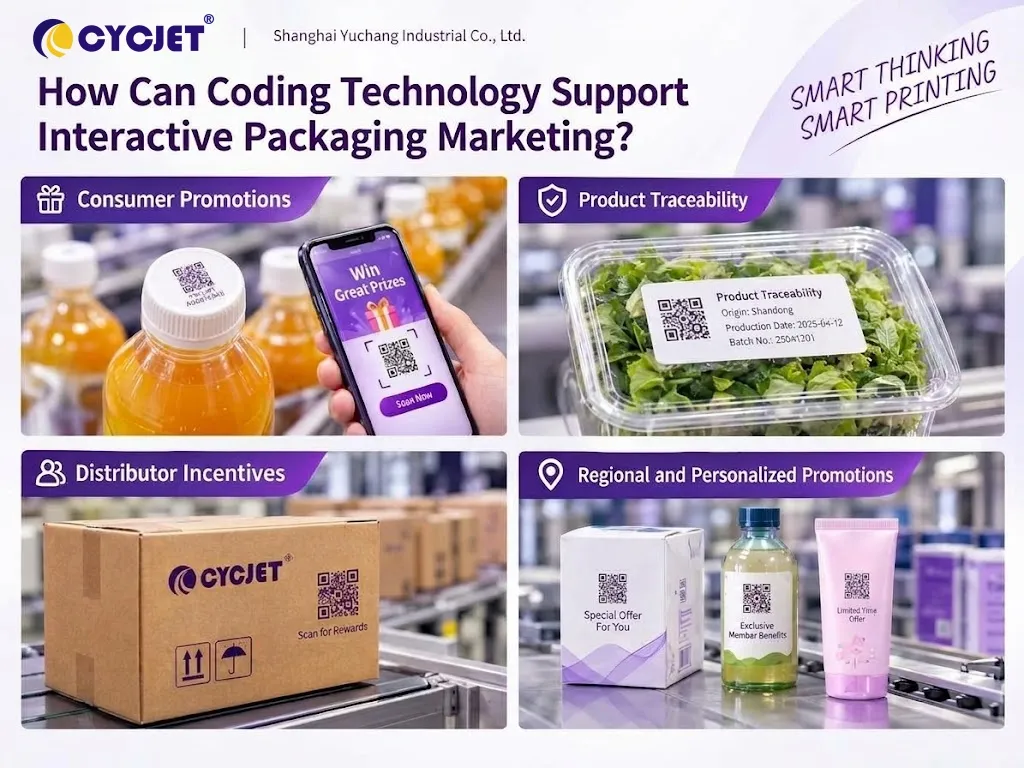
In actual projects, one-item-one-code is not limited to consumers scanning codes to receive prizes. According to the company's marketing goals and management needs, variable coding can also be combined with product traceability, channel incentives and other services.
Consumer QR Code Campaigns
By printing unique, variable QR codes on items such as bottle labels, caps, packaging bags, or cartons, brands enable consumers to scan the codes after purchase to enter lucky draws, claim coupons, or earn loyalty points.
For brands, assigning a distinct code to each individual product makes it possible to track the participation of specific items and provides a data foundation for driving repeat purchases. The ability to execute functions like distributing cash rewards (red envelopes), facilitating user registration, or building a member database depends on the specific feature design of the backend marketing platform.
Product Traceability and Brand Engagement
In sectors such as food, beverages, and other industries that demand high levels of product transparency, product codes can be linked to specific production batches, quality inspection records, or logistics data.
When consumers scan a code, they can not only view product-related information but also access pages for brand campaigns. By integrating product information with marketing initiatives, companies can satisfy the need for product transparency while simultaneously creating more opportunities to engage with consumers.
Distributor Incentives and Channel Management
For brands with multiple distributors and sales territories, individual product codes can be used in conjunction with outer-carton codes. Companies can establish scan-based incentive programs or point systems for distributors across different channels, while leveraging backend data to monitor product scanning activity.
Integrating these codes with logistics, warehousing, and channel management systems further enables the analysis of product flow and the identification of irregularities, such as anomalous scanning patterns. It should be noted that effective anti-diversion (anti-channel-conflict) management cannot rely solely on the codes themselves; it requires a comprehensive approach that integrates coding protocols, data systems, and established channel processes.
Regionalized and Personalized Marketing
The same product may be subject to different promotional campaigns depending on the region. Through variable data printing, companies can swap out QR codes, serial numbers, or promotional text during the production process, eliminating the inconvenience of frequently changing packaging printing plates.
For businesses with extensive product lines and frequently updated promotional activities, this approach also enhances the flexibility of applying codes to packaging.
三、 How can CYCJET coding equipment be adapted for different types of packaging?
The successful implementation of QR code-based marketing depends not only on the coding system itself, but also on factors such as packaging material, the specific location for printing, production line speed, and the requirements for code readability. Different application scenarios necessitate the selection of the most appropriate marking technology.
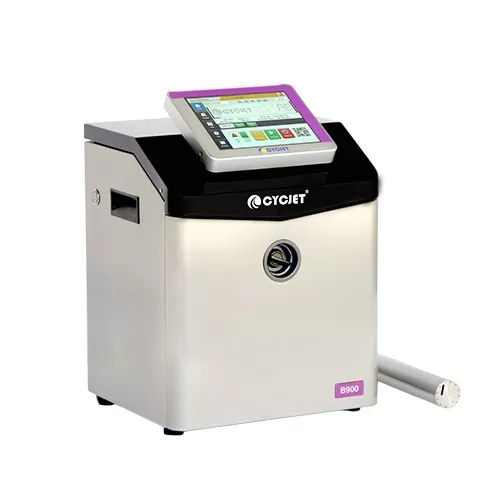
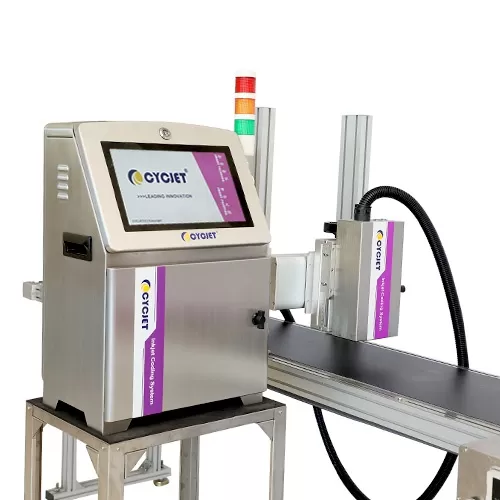
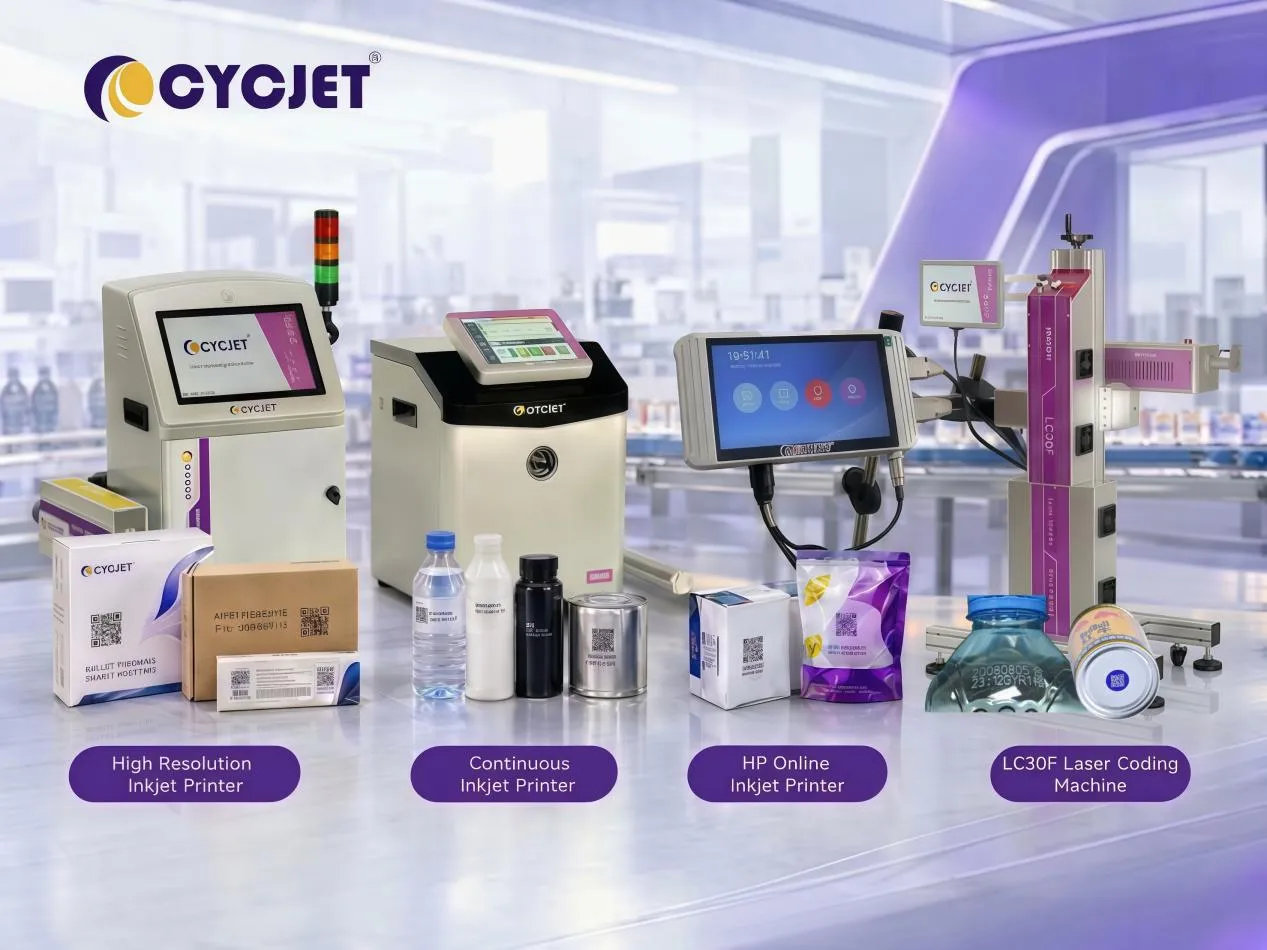
High-Resolution Inkjet Printer
Designed for use on the surfaces of packaging such as cartons, boxes, and paper bags, this system can print text, graphics, and various types of QR codes, depending on the specific equipment configuration and application requirements. A high-resolution coding solution is an ideal choice for scenarios that require displaying a large amount of information on outer packaging, or for simultaneously printing product details and marketing-related codes.
Suitable for continuous production environments, these printers can be used on the surfaces of various products—such as plastic bottles, pipes, and metal containers—to apply information like production dates, batch numbers, and other product-related data in-line. If a project involves QR codes or other variable data, it is necessary to conduct an assessment based on the specific model’s data processing capabilities, print resolution, and production line speed.
Suitable for applications such as paper boxes, cartons, and certain types of flexible packaging, these systems are ideal for production environments that handle various product specifications and require flexible, rapid switching of printed content. When selecting a system, it is essential to conduct tests based on factors such as the surface characteristics of the packaging, ink compatibility, printing distance, and production speed.
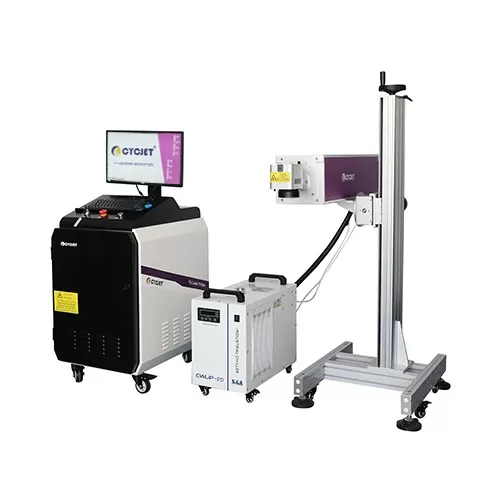
Laser marking creates marks on the surface of compatible materials, typically eliminating the need for traditional coding inks or thermal transfer ribbons. Depending on the material type and laser configuration, this technology can be used for marking items such as certain types of bottle caps, rigid plastics, and metal products. Laser marking is an excellent option for applications requiring wear-resistant marks or a reduction in consumable usage; however, the final marking quality and contrast should always be verified through actual sample testing.
For the one-to-one code project, the clarity, contrast, size and positioning accuracy of the QR code are all very important. Even if the normal production date can be properly printed, it does not mean that the QR code will definitely be able to be reliably read. Therefore, before selecting the equipment, it is recommended to conduct tests based on the actual packaging materials, target code size, production line speed and installation space.
四、Leveraging Product Identification to Unlock Added Value in Packaging
The primary function of coding and marking equipment remains the creation of stable, clear product identifiers. However, when variable data printing is integrated with QR code platforms, membership systems, or channel management systems, the codes on the packaging can take on broader business functions.
For companies planning to launch QR code-based marketing campaigns, it is essential to define several key elements in advance: what content to print, how QR codes are generated, how data is transmitted, what landing page users see after scanning, and how the production line integrates with the coding system.
CYCJET (Shanghai Yuchang Industrial Co., Ltd.) provides industrial coding and laser marking equipment, along with comprehensive application support. We can help evaluate the ideal marking solution based on your product materials, the specific content to be printed, and your existing production line conditions.
If you are planning a QR code marketing campaign, implementing variable data coding on packaging, or upgrading your production line’s marking capabilities, please contact CYCJET. We can conduct printing tests using your actual samples and production requirements to help you finalize the optimal equipment configuration and application strategy.
Contact Person: David Guo
Telephone: +86-21-59970419 ext 8008
MOB:+86-139 1763 1707
Email: sales@cycjet.com
Web: https://cycjet.com/
Keywords:
High resolution inkjet printer

WeChat QR code